Best Tool to Organise Your Whole Job Search in One Place
The best tool to organise your job search connects applications, CVs, recruiter messages, interviews, follow-ups and outcomes in one workspace.
 Lucien Krogel·July 21, 2026·11 min read
 Author:Lucien Krogel·Founder & CEO
If you have been applying for roles in 2026 and getting little back, the market is not gaslighting you. The UK labour market has become structurally more selective, and the data backs it up.
UK unemployment sits at 5.1 to 5.2%, its highest level in nearly five years. There are 2.6 unemployed people chasing every vacancy, the worst ratio since 2021. Job postings are still running 19 to 29% below pre-pandemic levels depending on the month. The BDO Employment Index hit its weakest reading in almost 15 years in February 2026.
This is not a collapsed market. Companies are still hiring. But the pool of available roles has shrunk, the competition per opening has risen sharply, and employers are taking longer and being more selective at every stage. That combination makes a volume-based application strategy far less effective than it was two or three years ago.
The rest of this article explains what is driving the toughness, which sectors still have demand, and what a smarter search looks like in this environment.
The headline unemployment figure tells part of the story. The detail underneath it tells the rest.
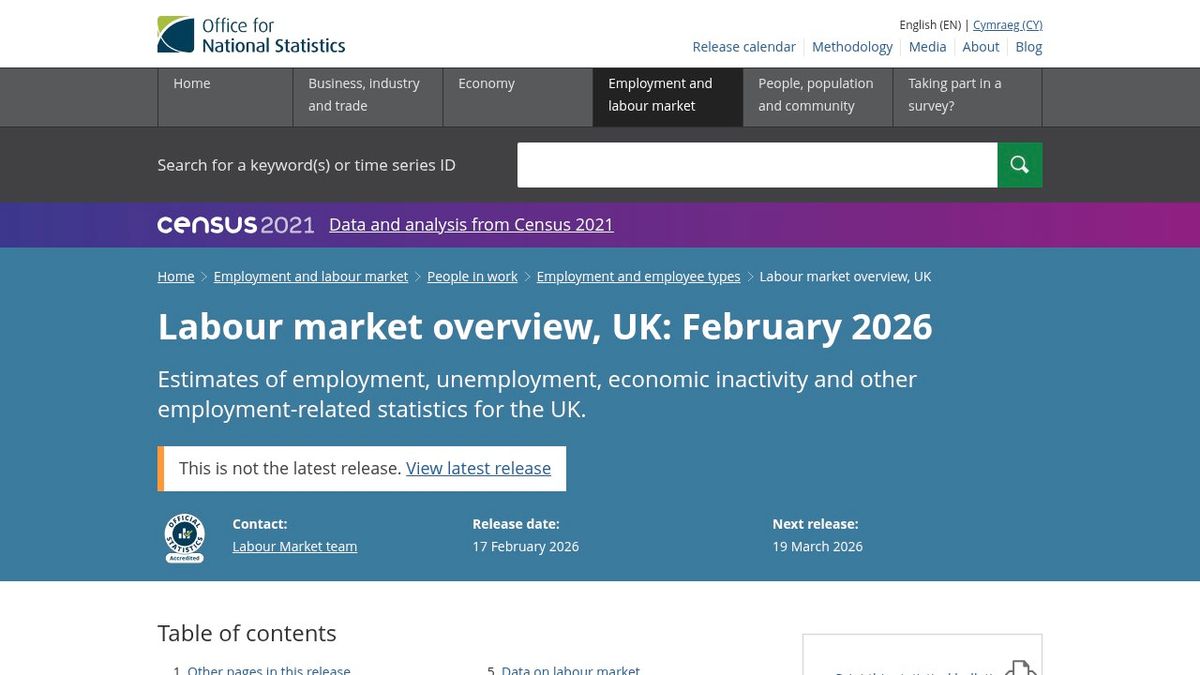
According to the ONS Labour Market Overview, the number of payrolled employees fell by 121,000 in the year to December 2025. That is not a mass-redundancy story - it reflects a sustained slowdown in net new hiring, with companies not replacing leavers, freezing headcount, or delaying roles that were approved but never opened. Vacancies stood at 726,000 in January 2026, down from a peak of around 1.3 million in 2022. The 38th consecutive quarterly decline in vacancies was reported by the Guardian in March 2026.
The vacancy-to-candidate ratio is the number that matters most for active job seekers. At 2.6 unemployed people per vacancy, the odds on any individual role are meaningfully worse than they were during the 2021 to 2022 hiring boom, when that ratio sat below 1.5.
Indeed Hiring Lab describes the market as "steady but subdued" - a phrase that captures the reality well. Hiring has not stopped, but the volume is lower, the pace is slower, and employers have more choice at every shortlist stage. For mid-career candidates, that means the bar for standing out has risen even as the number of available roles has fallen.
Three structural forces have converged in 2026 to make hiring slower and more selective. None of them are temporary blips.
From April 2026, the National Living Wage increased by 4.1% to £12.71 for workers aged 21 and over, with larger percentage increases for younger age bands. Employer National Insurance contributions also rose, adding directly to the cost of each hire. The CIPD noted in February 2026 that recruitment is likely to stay subdued as employers absorb these costs. When hiring becomes more expensive, companies approve fewer roles and take longer to fill the ones they do open.
The UK economy has not generated the growth needed to justify broad-based headcount expansion. In that environment, most companies default to holding the line: delaying backfills, merging roles, and raising the bar for what a new hire needs to deliver before approval is granted. According to the REC/KPMG Report on Jobs, both permanent and temporary hiring demand fell in March 2026, with the Guardian describing the jobs market as "floundering."
When employers have more candidates than roles, the hiring process slows down and the standard for shortlisting rises. Recruiters can afford to wait for a closer match. Hiring managers can ask for more evidence of measurable impact. Processes that took four weeks in 2022 now take eight. Indeed Hiring Lab describes employers as "cautious rather than pessimistic" - which is accurate, but cold comfort when you are waiting for a first-round response.
The net effect: fewer roles, slower processes, and a higher bar for every stage. That is the market mid-career professionals are navigating in 2026.
A difficult market does not mean every rejection is outside your control. The useful question is not “Is the market bad?” It is “Where is my search breaking down?”
Use this diagnostic:
| Signal | Likely issue | What to fix |
|---|---|---|
| No responses from 30+ applications | Targeting or CV relevance | Tighten role fit and tailor the top third of your CV |
| Some recruiter screens but few hiring manager interviews | Positioning | Make your measurable impact clearer |
| Interviews but no offers | Interview evidence or role fit | Improve examples, commercial outcomes, and follow-up |
| Many applications but no clear pattern | Tracking problem | Track conversion by role type, sector, and source |
| Strong roles go quiet after applying | Follow-up gap | Add a 7-10 day follow-up system |
The market is harder, but patterns still appear when you track the search properly. If every application is treated as a one-off, you cannot tell whether the issue is the role, the CV, the market, or the process.
The national figures mask significant variation by sector. Treating the whole market as one number is one of the most common mistakes active job seekers make.
According to the REC/KPMG Report on Jobs cited by the Guardian in March 2026, engineering was the only sector to show an increase in permanent staff demand. Everything else was flat or declining. The ONS recorded falling vacancy numbers in accommodation and food services, wholesale and retail, arts and entertainment, and real estate. The sharpest quarterly drops were in leisure and recreation (down 25.2% year-on-year) and real estate (down 28.1% year-on-year).
The technology sector tells a nuanced story. CompTIA's State of the Tech Workforce UK 2026 projects net tech employment growth of 1.02% in 2026, with the UK's net tech workforce sitting at approximately 2.148 million. That is modest growth, not a boom. But within it, demand is concentrated: cloud and DevOps, cybersecurity, AI and data engineering, and product-oriented technical roles are where openings are holding up.
The AI signal is worth paying attention to. Indeed Hiring Lab reports that AI skills are now mentioned in 5.6% of UK job postings, the highest proportion of any comparable country, and that AI-related job posting mentions have increased by 127% in the past year. That is not just a tech-sector trend. It is showing up across product, operations, and GTM roles too.
The practical implication: if your target roles sit in the stronger-demand column, the market is hard but workable. If they sit in the weaker column, a sector pivot or a sharper skills narrative may matter more than application volume.
Abstract market data only becomes useful when it maps to your specific situation. Here is what the 2026 conditions mean by function.
The common thread across all four: mid-career professionals have a genuine advantage over junior candidates, but only if they make their measurable impact explicit. In a selective market, a CV that describes what you did is weaker than one that shows what changed because of you.
The UK market is not equally hard for every profile. Your next move depends on the role family you are targeting.
| Role family | What to emphasise | Next action |
|---|---|---|
| GTM and sales | Pipeline, quota, revenue impact, territory, segment | Lead with commercial outcomes |
| Customer Success | Retention, expansion, onboarding, account size, product adoption | Show customer and revenue impact |
| Project Management | Delivery scope, governance, risk, stakeholder complexity | Prove delivery under constraint |
| Operations | Automation, cost reduction, workflow redesign, cross-functional execution | Connect ops work to business impact |
| Tech and data | Tools, systems, shipped work, measurable technical outcomes | Show what changed because of your work |
In a selective market, broad responsibility is weaker than specific evidence. The more clearly you show the outcome you create, the easier it is for a recruiter to justify moving you forward.
When vacancy volume is down and employer selectivity is up, the spray-and-pray approach does not just underperform - it actively wastes the time you should be spending on preparation and positioning. Here is what a disciplined 2026 search looks like.
If the market is tighter, the answer is not to apply everywhere. Start with a focused 30-day search sprint.
| Week | Focus | Output |
|---|---|---|
| Week 1 | Tighten target roles | 15-20 roles that match your function, level, and evidence |
| Week 2 | Rebuild application materials | One strong master CV and 2 role-specific variants |
| Week 3 | Apply selectively | 8-12 high-fit applications with tailored CVs |
| Week 4 | Review conversion | Track responses, rejections, recruiter screens, and interviews |
If there are no responses after Week 4, do not simply send more applications. Review the pattern. The issue is usually one of three things: your target roles are too loose, your CV evidence is not specific enough, or your follow-up system is missing.
In a market where the average role attracts significantly more candidates than it did three years ago, the cost of a missed follow-up, a duplicated application, or a poorly tailored CV is higher than it used to be. Each wasted application is time that could have gone into preparation for a role you were genuinely well-positioned for.
A harder market needs a sharper system
When vacancies are lower and employers are more selective, the margin for error gets smaller. A weak-fit application, missed follow-up, or generic CV costs more in 2026 than it did during the hiring boom.
Ask Tua is being built to help UK job seekers run a more disciplined search: match roles to their profile, track applications, tailor CVs, manage follow-ups, and prepare for interviews in one workspace.
The first 50 beta places are opening soon. If you want to stop guessing where your search is breaking down, join the waitlist.
Join the Ask Tua beta waitlist
The UK job market feels harder in 2026 because vacancies are lower, competition per role is higher, and employers are hiring more selectively. ONS data shows unemployment around 5.2%, vacancies at 726,000, and roughly 2.6 unemployed people per vacancy, which makes every application more competitive.
Slowly stabilising, but not recovered. Vacancies have been falling for 38 consecutive quarters and unemployment has risen for 36 consecutive months. Indeed Hiring Lab describes conditions as "steady but subdued." There are early signs of stabilisation, but the market remains well below pre-pandemic hiring levels and is unlikely to return to 2021 to 2022 conditions in the near term.
Engineering, technology (particularly cloud, DevOps, cybersecurity, and AI/data), and revenue-linked commercial roles are showing the most relative resilience. Product management roles exist but hiring is more selective. Retail, hospitality, leisure, real estate, and manufacturing are all seeing falling vacancy numbers according to ONS data.
There is no reliable universal figure, and focusing on volume is the wrong frame. What matters is conversion rate: how many applications lead to a first-round interview. In a selective market, a lower volume of well-targeted, well-tailored applications will typically outperform a high volume of generic ones. Track your own conversion rate and optimise from there.
It could be the market, your targeting, your CV, or a combination of all three. With 2.6 candidates per vacancy, competition is genuinely higher. But if your application-to-interview rate is below roughly 5 to 10%, it is worth auditing your CV tailoring, the match quality of the roles you are applying to, and whether your measurable impact is clearly stated. The Ask Tua guide to UK job search in 2026 covers how to diagnose where applications are stalling.
Start by checking whether the problem is targeting, CV relevance, or follow-up. If you have sent 30+ applications with no response, reduce volume and audit role fit. Your CV should clearly match the job title family, skills, and measurable outcomes in the roles you are targeting.
Not usually. In a selective market, more applications only help if the roles are a strong fit. A smaller number of targeted applications with tailored CVs, clear evidence, and consistent follow-up will usually outperform a high volume of generic applications.
About the Author

Lucien Krogel
Founder & CEO
Lucien founded Ask Tua after six years coaching people through complex job searches. He kept seeing strong candidates lose momentum because their roles, CVs, recruiter messages, interviews, follow-ups and outcomes were scattered across different tools. He built Ask Tua as an AI job search assistant with a connected workspace, so candidates can understand what is happening in their search and decide what to do next.
Full Bio → Blog
BlogThe best tool to organise your job search connects applications, CVs, recruiter messages, interviews, follow-ups and outcomes in one workspace.
Lucien Krogel·July 21, 2026·11 min read Blog
BlogCompare AI job matching and auto-apply tools to see which approach helps you find better-fit roles, avoid generic applications and get more interviews.
Lucien Krogel·July 10, 2026·12 min read Guide
GuideFeel stuck in your job search? Learn why next-step uncertainty happens, how to spot the real signal, and how Ask Tua helps you decide what to do next.
Lucien Krogel·July 23, 2026·12 min read