Best Tool to Organise Your Whole Job Search in One Place
The best tool to organise your job search connects applications, CVs, recruiter messages, interviews, follow-ups and outcomes in one workspace.
 Lucien Krogel·July 21, 2026·11 min read
 Author:Lucien Krogel·Founder & CEO
Customer Success roles are hard to track because every company asks for something slightly different: product knowledge, stakeholder management, renewals experience, onboarding skills, and commercial judgement. Ask Tua helps Customer Success candidates organise applications, tailor CVs, prepare for interviews, and keep follow-ups under control across every stage of the search.
In a market where a single Customer Success Manager posting can attract 300 to 1,000 applications, applying faster is not a competitive advantage if the applications are generic. Hiring managers in CS roles are experienced at spotting CVs that have been keyword-stuffed to pass a filter but say nothing meaningful about retention, onboarding, or commercial outcomes.
The real risk is not that you apply too slowly. It is that you apply too broadly, with CVs that look efficient but read as interchangeable.
This guide covers three things:
By the end, you will have a practical system: track every opportunity with the right context, tailor every CV around Customer Success outcomes, and apply human judgement before you hit submit. That combination gives you a stronger pipeline, better interview rates, and a clearer read on your market value in a category that is still growing.
Customer Success is not a niche function anymore. The Customer Success Management market was valued at $2.20 billion in 2025 and is projected to reach $2.68 billion in 2026, with the broader Customer Success Platforms segment expected to grow at a compound annual growth rate of 22.1% through 2032. That growth reflects how seriously B2B companies are investing in retention and expansion, which means demand for skilled CS professionals is not disappearing.
Salaries reflect the category's maturity. The average Customer Success Manager salary is expected to reach approximately $93,800 in 2026, up from $83,600 in 2022. For candidates in the UK and Europe, equivalent roles at growth-stage and enterprise tech companies remain well-compensated, particularly at the Senior CSM, Strategic CSM, and CS Team Lead levels.
The competition, however, is real. Hiring expectations have shifted. Employers now want CS candidates who can demonstrate AI fluency, data literacy, and commercial accountability alongside the traditional skills of onboarding, relationship management, and renewal. A strong CS CV in 2026 is not just a list of accounts managed. It is evidence of outcomes.
Not all Customer Success roles are the same. Candidates who target broadly, without distinguishing between role types, end up with CVs that fit none of them well.
Knowing which category fits your background is the first decision in a structured search. It shapes which roles you prioritise in your tracker and which CV language you ask AI tools to emphasise.
A job application tracker is, at its core, a pipeline management tool. Used properly, it gives candidates the same visibility over their search that a sales team has over its deals: where each opportunity stands, what action is needed next, and which conversations are going cold.
The practical benefit is not glamorous, but it is significant. Without a tracker, candidates routinely apply to the same role twice, miss follow-up windows, forget which version of their CV they submitted, and lose track of salary context they gathered during research. A tracker removes that friction.
The mistake most candidates make is tracking only application status. That is the minimum. Strong candidates track considerably more:
For Customer Success candidates specifically, the notes field is underused. Recording why a role fits your background, which CS skills are most relevant, and what the company's retention challenges might be gives you a head start in every conversation.
Trackers organise effort. They do not improve candidate quality. This is an important distinction, because it is easy to spend time building a well-structured tracker and mistake that activity for progress.
A tidy spreadsheet with 40 applications in it is not a strong job search. It is an organised one. If the underlying CVs are generic, the follow-up emails are templated, and the roles were selected without strategic filtering, the tracker has just made the problem more visible, not smaller.
The honest summary: a job application tracker is a foundation, not a strategy. It creates the structure that lets you apply selectively, follow up consistently, and learn from response patterns over time. But it only works if the applications going into it are worth tracking in the first place.
That is where AI resume optimisation tools come in, and where the combination of both tools becomes genuinely useful.
AI resume tools have a genuine use case. The issue is that most candidates either over-rely on them or dismiss them entirely. The reality sits in the middle: these platforms are strong at specific tasks and weak at others, and knowing the difference is what separates candidates who use them effectively from those who produce polished-looking but unconvincing applications.
Speed on first drafts. AI tools can take a job description and a base CV and produce a tailored version in minutes. For candidates applying to multiple CS roles across different company types, this dramatically reduces the time cost of customisation. The alternative, rewriting from scratch for each application, is slow enough that most candidates skip it entirely and send a generic CV instead.
ATS keyword alignment. Most enterprise hiring processes route applications through an Applicant Tracking System before a recruiter reviews them. Indeed estimates that over 75% of large employers use ATS software as part of their hiring workflow. AI tools that scan job descriptions and identify the 15 to 20 most relevant keywords give candidates a practical advantage in passing that initial filter. This is not about gaming the system; it is about ensuring your CV uses the same language the job description does, which also makes it easier for a human reviewer to see the fit quickly.
Translating transferable experience. For candidates moving into Customer Success from account management, support, project management, or operations, AI tools can help reframe existing experience in CS-relevant language. This is one of the most time-consuming parts of a career pivot, and AI does it faster than most people can manage manually.
The practical benchmark: use AI to get to a strong first draft faster. Then edit it yourself.
The risks of AI resume optimisation are real, and they are not always obvious until a candidate has already sent several applications. Understanding them does not mean avoiding these tools. It means using them with enough judgement to avoid the most common failure modes.
AI tools are trained on large volumes of existing CV content. The output they produce tends to reflect the most common phrasing patterns in that training data. As Kahn Litwin's analysis of AI resume tools notes: "AI often produces common phrases that can make resumes sound interchangeable."
For Customer Success candidates, this is a specific problem. CS hiring managers read hundreds of CVs that describe candidates as "passionate about customer outcomes" and "experienced in driving adoption." These phrases are not wrong. They are just invisible. A CV that reads like every other CS application does not get shortlisted, regardless of how well it passed the ATS filter.
There is a meaningful difference between aligning your CV language with a job description and keyword-stuffing it. Excessive keyword insertion makes CVs read unnaturally, which experienced recruiters notice immediately. The goal is fluency plus relevance, not density.
The tools that perform best are the ones candidates use as accelerators, not replacements for their own judgement.
The candidates who get the most out of these tools do not treat them as separate products. They run a workflow that connects targeting, tracking, tailoring, and review into a single loop. Here is what that looks like in practice.
Step 1: Define your target role framework before you open any job board. Decide which CS role types fit your background (refer to the role spectrum table above). Pick two or three categories maximum. This decision shapes every subsequent step: which roles go into your tracker, which CV language you prioritise, and which AI outputs you accept or reject.
Step 2: Build your base CV with strong CS evidence. Before using any AI tool, create a base CV that includes your real metrics: retention rates, onboarding timelines, NRR contribution, expansion revenue, accounts managed, and any cross-functional delivery. AI tools cannot invent these numbers. You need to supply them. A base CV with genuine evidence is the raw material that makes AI tailoring useful.
Step 3: Add roles to your tracker before you apply. When you find a role worth considering, log it in your tracker first. Record the company, role type, salary range, key requirements, and why it fits your target framework. This step forces a brief evaluation before you commit time to tailoring. If a role does not meet your criteria on review, remove it rather than applying out of habit.
Step 4: Use AI to tailor your CV for roles that pass the filter. For roles you have decided to pursue, use an AI resume tool to adapt your base CV to the specific job description. Prompt it to align your experience with the role's language, surface the most relevant CS skills, and suggest how to frame your metrics in context. Then review the output critically.
Step 5: Edit the AI output before submitting. Read every AI-generated CV before it goes out. Remove generic phrases. Restore your specific language. Check that every metric is accurate. Confirm the CV sounds like a person, not a template.
Step 6: Update your tracker after each application. Log the CV version used, the date applied, and the follow-up date. Set a reminder. When a response comes in (or does not), note the outcome and look for patterns across your pipeline.
Customer Success CVs fail for one of two reasons: they are too generic (no evidence of CS-specific outcomes) or they are too task-focused (describing what the candidate did rather than what it produced). Hiring managers in CS are looking for proof of commercial and operational impact, not a job description rewritten in first person.
Regardless of which CS role type you are targeting, your CV needs to demonstrate some combination of the following:
Career coaches consistently recommend that approximately 60% of CV bullet points should include a metric of some kind. The metric does not need to be a revenue figure. Onboarding timelines, adoption rates, account counts, and retention percentages all demonstrate the same thing: that the candidate can point to outcomes, not just activities.
These examples show how adjacent experience from account management, support, and operations roles can be reframed without exaggerating or fabricating anything.
AI tools can help you structure these rewrites faster. But the numbers in the "After" column have to come from you. No AI platform can supply your actual retention rate or your real expansion contribution. That is the part that makes a CS CV credible.
Most candidates pick tools based on what comes up first in a search or what a peer mentioned. A more useful approach is to match the tool to the specific gap in your current search.
If your primary problem is disorganisation: you are losing track of applications, missing follow-ups, and cannot see your pipeline clearly. Start with a tracker. Get that foundation in place before adding any AI tooling.
If your primary problem is CV quality: you are getting into the pipeline but not progressing, or you are not getting responses at all despite applying to relevant roles. Start with AI resume support and focus on outcome-based tailoring.
If you want both in one place: an all-in-one job search assistant that combines tracking, CV support, job matching, and coaching removes the friction of managing separate tools and gives you a single view of your search.
The last two features, job matching and coaching integration, are where standalone trackers and standalone AI resume tools both fall short. Matching requires a live job feed and profile logic. Coaching requires context about your background and target roles. These capabilities become significantly more useful when they sit alongside your tracking and CV workflow rather than in a separate product.
The Customer Success job market is active and growing. That is the good news. The competitive reality is that the same growth attracting more candidates means a generic application has less chance of standing out than it did three years ago.
The candidates who get interviews are not the ones who apply the most. They are the ones who apply with the most precision: targeted roles, tailored CVs, consistent follow-up, and a clear record of CS-specific outcomes that hiring managers can evaluate quickly.
The winning setup, in brief:
The tools covered in this guide are most powerful when they sit together in a single workflow. Tracking, job matching, CV tailoring, and coaching in one place means less admin, fewer gaps, and more time spent on the preparation that actually moves conversations forward.
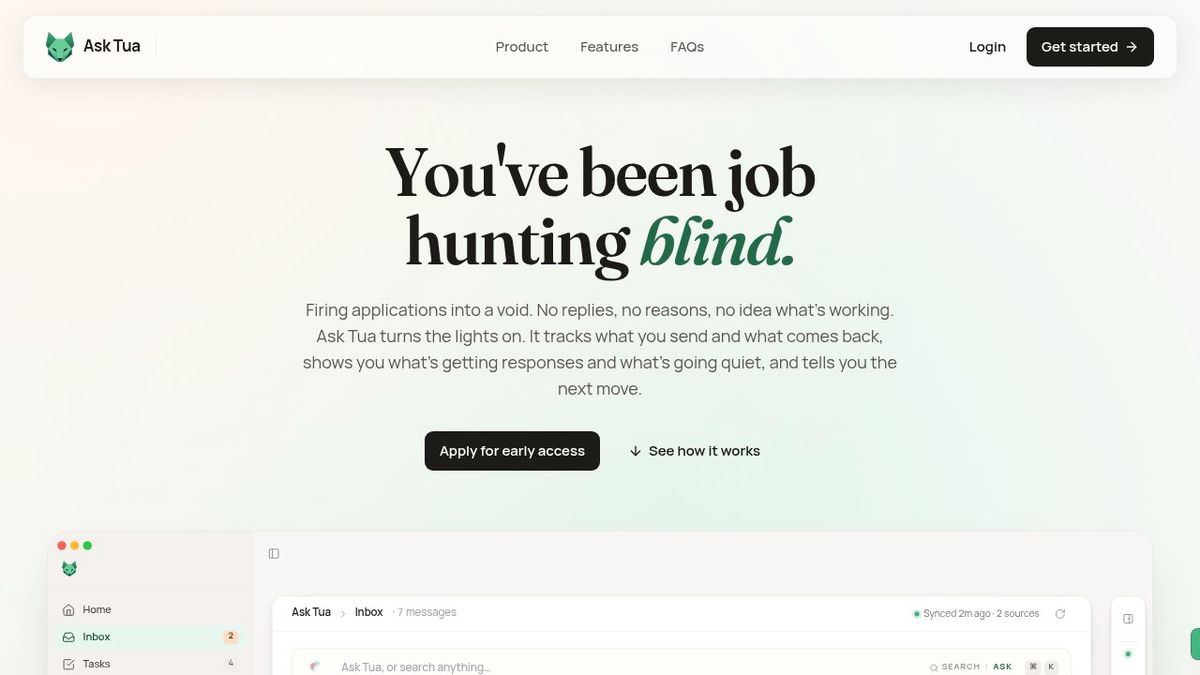
Ask Tua is built for exactly this workflow. One dashboard for your entire job search: applications, inbox, job matching, cover letters, and interview prep. The first 50 beta spots are opening soon. Join the waitlist and be first in.
Yes, and arguably more so. If you are running a selective search with 10 to 20 high-priority applications rather than 50 to 100 mass applications, each opportunity matters more. A tracker ensures you follow up at the right time, remember the context of each conversation, and do not miss a deadline on a role you genuinely want. The organisational overhead is minimal once the system is set up.
They help with ATS alignment, which is a meaningful but limited benefit. An AI tool that extracts the most relevant keywords from a job description and checks whether your CV includes them will improve the chances of passing an automated filter. What it cannot do is guarantee a human will find your application compelling once it clears that filter. ATS alignment is table stakes. The quality of your evidence and the clarity of your outcomes are what drive interviews.
They help when you use them for faster tailoring, keyword alignment, and clearer framing of your experience. They do not replace judgement. The strongest results come when you edit the output, keep your CV specific, and tailor for the right Customer Success roles.
Quality over volume is the right framework. A focused search of 10 to 15 active applications, each properly tracked and tailored, will consistently outperform a spray-and-pray approach of 60 to 80 generic submissions. The research benchmark of 300 to 1,000 applications per posting should make candidates more selective, not less. If the competition is that high, a generic CV has almost no chance. A well-tailored one does.
Separate tools work if you are disciplined enough to maintain two workflows simultaneously. In practice, most candidates are not. The friction of switching between a tracker, an AI resume tool, a job board, and a coaching resource leads to gaps: follow-ups missed, CV versions lost, context forgotten. An integrated platform that handles tracking, job matching, CV tailoring, and coaching in one place removes that friction and gives you a single source of truth for your entire search.
Using them to apply to more roles rather than to apply better to fewer roles. The tools exist to raise the quality and efficiency of each application. When candidates use them to increase volume instead, they end up with a well-organised pipeline of weak applications. The output is faster rejection, not more interviews.
Retention, onboarding, adoption, stakeholder management, and measurable outcomes. If you are moving from account management, support, operations, or project roles, translate that experience into customer impact language with real metrics wherever possible.
About the Author

Lucien Krogel
Founder & CEO
Lucien founded Ask Tua after six years coaching people through complex job searches. He kept seeing strong candidates lose momentum because their roles, CVs, recruiter messages, interviews, follow-ups and outcomes were scattered across different tools. He built Ask Tua as an AI job search assistant with a connected workspace, so candidates can understand what is happening in their search and decide what to do next.
Full Bio → Blog
BlogThe best tool to organise your job search connects applications, CVs, recruiter messages, interviews, follow-ups and outcomes in one workspace.
Lucien Krogel·July 21, 2026·11 min read Blog
BlogCompare AI job matching and auto-apply tools to see which approach helps you find better-fit roles, avoid generic applications and get more interviews.
Lucien Krogel·July 10, 2026·12 min read Guide
GuideFeel stuck in your job search? Learn why next-step uncertainty happens, how to spot the real signal, and how Ask Tua helps you decide what to do next.
Lucien Krogel·July 23, 2026·12 min read