Why You Never Know What to Do Next in Your Job Search
Feel stuck in your job search? Learn why next-step uncertainty happens, how to spot the real signal, and how Ask Tua helps you decide what to do next.
 Lucien Krogel·July 23, 2026·12 min read
 Author:Lucien Krogel·Founder & CEO
You have probably heard that ATS systems reject 75% of CVs before a human ever reads them. It is one of the most repeated claims in job search advice, and it has sent thousands of candidates down a rabbit hole of keyword stuffing, ATS scanner tools, and formatting hacks that do not move the needle.
Here is what the data actually says: according to a 2025 survey published by HR.com, 92% of recruiters reported their ATS does not automatically reject CVs based on content or formatting. The remaining 8% said some auto-rejection is used, typically for hard filters like missing qualifications or location requirements set explicitly by the employer, not a robot reading your bullet points and deciding you are unworthy.
The real picture is less dramatic, and more fixable:
That reframe matters. If ATS were an unbeatable wall, there would be nothing to do except get lucky. But if it is a ranking system, then relevance, clarity, and targeting are levers you can actually pull.
This article explains how ATS ranking works, what factors move your CV up the queue, and what mid-career professionals in operations, project management, customer success, and sales roles can do about it right now.
Most candidates try to fix ATS problems with formatting tweaks, keyword scanners, or repeated phrases from the job description. That usually misses the real issue.
A CV ranks better when it gives the ATS and the recruiter clearer evidence of fit. That means the page has to show the right title family, the right skills, the right tools, and the right outcomes in a structure that can be parsed cleanly.
The strongest CVs do three things at once:
That is why Ask Tua’s CV method starts with evidence, not decoration. The goal is not to “beat” an ATS. The goal is to make your most relevant experience impossible to miss.
Most candidates think of the ATS as a single filter sitting between them and a recruiter. In practice, it is a sequence of steps, and understanding that sequence tells you exactly where ranking is decided.
Here is how the process works in platforms like Greenhouse, Workday, and Lever:
The implication is straightforward. If your CV is ranked 40th out of 60 applicants, a busy recruiter filling one role may never reach you. You were not rejected. You were simply never opened.
This is why "getting past the ATS" is the wrong goal. The right goal is ranking high enough to be in the first wave of CVs a recruiter actually reads.
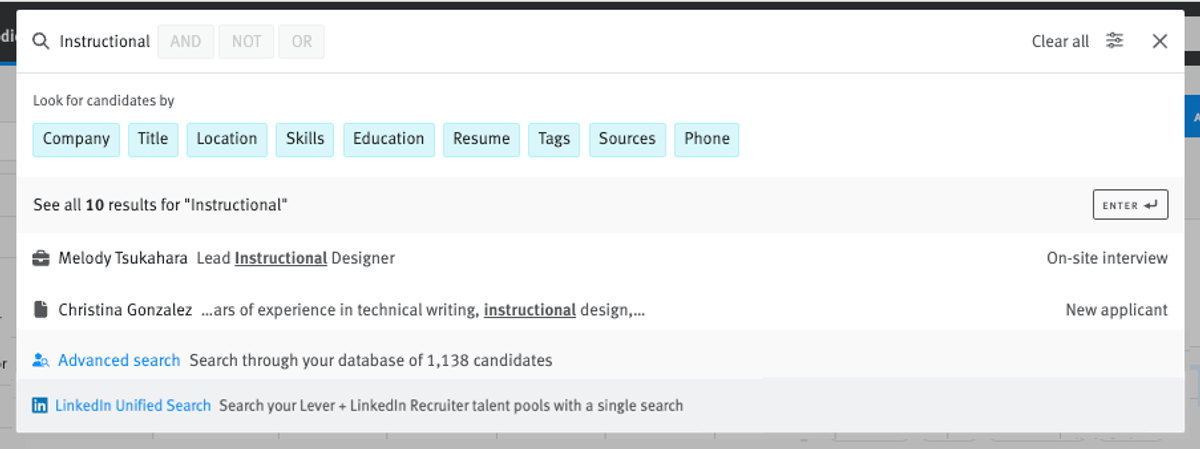
The Lever candidate database search: recruiters filter and surface candidates by keyword, tag, and role match, working from a ranked, searchable queue rather than a simple pass/fail list.
ATS ranking is not a single score generated by one formula. Different platforms weight factors differently, and AI-assisted parsing is becoming standard. That said, the core ranking signals are consistent across Greenhouse, Workday, Lever, and most enterprise ATS platforms.
Here is how the main ranking factors break down:
One important nuance: keyword relevance is about context, not repetition. Mentioning "stakeholder management" once in a specific, outcome-driven bullet carries more weight than repeating it three times in vague sentences. Maywise's 2026 ATS guide puts it plainly: "The real risk is complex layouts, tables, text boxes, or image-based content that makes parsing harder" , not the absence of a keyword in every section.
A word on match score tools: third-party scanners like Jobscan and Resume Worded will give you a percentage and call it your "ATS score." There is no published evidence that a high score from one of these tools reliably predicts whether a recruiter actually opens your CV. They measure keyword overlap against a job description. That is not the same as how a real ATS ranks you inside Greenhouse, Workday, or Lever. Chasing a high scanner score is not the same as improving your ranking.
A lot of ATS advice circulating online is either outdated, oversimplified, or actively counterproductive. Here is what the evidence says about the most common mistakes.
Mid-career professionals often have the hardest time with ATS ranking, and it is not because they lack experience. It is because they have too much of it, spread across too many directions.
A CV that covers eight years of operations work, two years of account management, a stint in project coordination, and some customer success is not a strong signal for any one of those roles. The ATS sees a broad profile and assigns a moderate match score across the board, rather than a strong score for the specific role you are applying for.
As one resume optimisation expert puts it: "Your value is selectivity: surfacing only the experience that matches the job's current priorities."
TieTalent's 2026 ATS guide frames it well: "Write for humans first, then make the resume easy for machines to parse." The best-ranked CVs are not the ones that game the system. They are the ones that clearly and cleanly communicate genuine relevance.
If you are sending out a lot of applications and not hearing back, the issue is almost always targeting and relevance, not a mysterious ATS wall. Read more on diagnosing that gap in 50+ Applications, 2-3 Interviews? Here's How to Diagnose the Problem.
Purdue Global's career guidance recommends a hybrid format for mid-career professionals: a skills summary at the top, followed by reverse-chronological experience. This structure works well for ATS because it surfaces your most relevant signals early, before the parser has to dig through a decade of job history.
A high-ranking mid-career CV typically follows this pattern:
Here is the kind of summary that tanks ATS ranking for operations and project management roles:
This contains no job title, no specific skills, no tools, and no outcomes. The ATS extracts almost nothing useful from it.
Here is the same candidate rewritten for a Senior Operations Manager role:
The rewrite includes the target title, two specific domain areas, a named tool, a team size, a metric, and a concrete outcome. Every element is parseable, indexable, and relevant to the role.
The difference is not creativity. It is specificity. The ATS can extract and score the second summary. The first is invisible.
For a detailed walkthrough of CV tailoring for tech-adjacent roles, see Tailor Your CV for Tech Roles in 5 Steps.
Most CV advice jumps straight to bullet points. Ask Tua starts one step earlier: context.
A recruiter cannot judge the strength of an achievement if they do not understand the environment it happened in. Leading a project in a 20-person startup is different from leading one across a 5,000-person enterprise. Managing £80,000 is different from managing £8 million. Supporting five customers is different from owning a portfolio of 80 enterprise accounts.
That is why every strong Ask Tua CV starts each role with a short company context line before the bullets.
A good context line explains:
This gives the recruiter scale before they read the achievements. It also gives the ATS clearer entity signals around company type, sector, geography, and role context.
Weak role entry:
Stronger Ask Tua-style role entry:
The stronger version gives both software and humans more to work with: company type, customer scale, team size, functional scope, measurable outcomes, and relevant operating context.
That is the difference between listing responsibilities and proving fit.
Once the role context is clear, the bullets need to prove different kinds of value. Ask Tua uses five bullet categories so the CV does not become a flat list of responsibilities.
A strong role entry usually starts with responsibility and scope, then adds measurable outcomes, financial impact, and timeframe-bound achievements. This makes the CV easier to scan, easier to rank, and easier to believe.
ATS systems do not understand achievement quality like a senior recruiter does, but they can parse the signals inside well-written bullets: role titles, tools, skills, metrics, dates, teams, sectors, and outcomes. Strong bullets help because they create more relevant, structured evidence without stuffing the page with disconnected keywords.
The biggest practical barrier to good ATS ranking is not knowledge. It is time. Most mid-career professionals know they should tailor their CV per role, but the idea of rewriting the whole document for every application is exhausting, so they send a generic version and wonder why nothing comes back.
The fix is a system, not more effort.
You do not need to rewrite the whole CV for every application. You need to tailor the four zones that carry the most ranking and recruiter-review weight.
The aim is not to make every CV artificially different. It is to make the most relevant evidence visible first. Once you have two or three solid templates for your target role families, each new application takes 15-20 minutes, not two hours.
This is also where a structured job search system pays off. When your applications, job descriptions, and CV versions are organised in one place, you can track what you changed, what worked, and where you need to improve. How to use AI for your job search in 2026 covers how to build that system without sounding generic.
If you are applying consistently and not hearing back, the issue is almost always one of three things: your CV is reaching recruiters but not compelling them to act (a human readability problem, not an ATS problem), you are applying for roles where your experience is a loose fit rather than a strong match, or your application volume is high but your targeting is scattered. The ATS optimisation myth article covers what actually drives interview rate once you stop chasing scanner scores.
The same CV will not rank equally well for every role, even if the candidate is capable of doing all of them.
A Project Management role may prioritise delivery methodology, stakeholder management, certification, governance, and risk. A Customer Success role may prioritise renewals, onboarding, account health, product adoption, and executive relationships. A GTM role may prioritise pipeline, quota, territory, sales cycle length, and revenue impact.
That is why mid-career candidates should not run one generic CV across multiple role families. If you are applying across two or three paths, create a tailored version for each path.
Start with the role-specific guides if your search is focused:
The ATS is not the enemy. It is a ranking layer that rewards relevance, clarity, and targeting. Once you understand that, the anxiety around "getting past the ATS" dissolves, and you can focus on the things that actually improve your results.
Here is what this article comes down to:
The candidates who get interviews at the right companies are not the ones who found a clever ATS hack. They are the ones running a targeted, organised search where every application is genuinely matched to the role.
That is the system Ask Tua is built on: methodology from 300+ real coaching engagements, now inside a single job search dashboard. Applications, job matching, CV tailoring, and interview prep in one place, so you spend your time preparing, not admin.
Stop trying to beat the ATS. Build a better-fit CV.
Ask Tua is being built for job seekers who want a more structured search: better role matching, clearer CV tailoring, application tracking, and interview prep in one workspace.
The first 50 beta places are opening soon. Join the waitlist to get early access and help shape how Ask Tua supports CV tailoring before public launch.
Join the Ask Tua beta waitlist
ATS systems usually parse your CV into fields like title, employer, dates, skills, and education, then compare that data with the job description. Relevance, title alignment, keyword match, and clean structure all help determine whether your CV appears near the top of the recruiter queue.
Yes, in most cases. Clean, text-based PDFs exported from Word or Google Docs parse reliably on modern platforms including Greenhouse and Lever. DOCX files may parse slightly more consistently in some older systems, but PDF is widely accepted. The issue is never the file format itself. It is whether the PDF contains actual text (parseable) or is a scanned image (not parseable). If you designed your CV in Canva or exported it as an image, that is the problem, not the extension.
No. ATS systems do not penalise length. Two pages is appropriate for most mid-career professionals. What does hurt ranking is padding: irrelevant roles, vague summaries, and responsibilities that add word count without adding match signals. If your second page is full of evidence relevant to the target role, it helps. If it is a list of jobs from 2008, cut it.
Usually not. Most modern ATS setups rank and sort applicants instead of auto-rejecting them for content or formatting alone. Rejection is more likely when an employer sets hard filters such as location, eligibility, or required qualifications that are missing from the application.
A CV ranks higher when it is easy to parse and closely aligned to the role. Use standard headings, a clear job title, a short targeted summary, a relevant skills cluster, and experience bullets that reflect the language, tools, and outcomes in the job description.
No. Repeating keywords rarely helps and can make the CV weaker for a human recruiter. A better approach is to use the most important terms once or twice in the right context, backed by specific evidence, metrics, and relevant experience.
Rarely. Most ATS platforms process the CV separately from the cover letter. Some systems do not parse the cover letter at all. Write a strong cover letter for the human recruiter who opens your application, but do not rely on it to boost your ATS score.
No. ATS ranking is a composite score, not a checklist. Missing one term from a job description will not disqualify you. Missing the five most prominent skills, tools, and title keywords in a competitive role will push you down the queue significantly. Focus on the terms that appear repeatedly and prominently in the JD, not on achieving 100% coverage of every phrase.
If you are applying consistently but not hearing back, the issue is often targeting rather than the ATS itself. Tighten the role match, tailor the top of the CV for each role family, and compare your application pattern against the jobs that actually lead to interviews.
First, ignore the score. Third-party ATS scanners like Resume Worded, Jobscan, and similar tools generate a percentage that has no reliable correlation with actual callback rate. There is no published evidence that a high score from one of these tools meaningfully predicts whether a recruiter opens your CV. They measure keyword overlap against a job description, not how a real ATS ranks you inside a specific employer's system. A "92% match" from a scanner is not the same as ranking in the top 10 applicants in Greenhouse or Lever.
About the Author

Lucien Krogel
Founder & CEO
Lucien founded Ask Tua after six years coaching people through complex job searches. He kept seeing strong candidates lose momentum because their roles, CVs, recruiter messages, interviews, follow-ups and outcomes were scattered across different tools. He built Ask Tua as an AI job search assistant with a connected workspace, so candidates can understand what is happening in their search and decide what to do next.
Full Bio → Guide
GuideFeel stuck in your job search? Learn why next-step uncertainty happens, how to spot the real signal, and how Ask Tua helps you decide what to do next.
Lucien Krogel·July 23, 2026·12 min read Guide
GuideLearn how to track job applications, recruiter messages, follow-ups, interview stages and next actions in one connected job search system.
Lucien Krogel·July 22, 2026·11 min read Guide
GuideCompare the best AI job search assistant for active searches. See what matters, what ChatGPT misses, and why connected context changes the result.
Lucien Krogel·July 21, 2026·12 min read