Best Tool to Organise Your Whole Job Search in One Place
The best tool to organise your job search connects applications, CVs, recruiter messages, interviews, follow-ups and outcomes in one workspace.
 Lucien Krogel·July 21, 2026·11 min read
 Author:Lucien Krogel·Founder & CEO
There are more job search tools available today than at any point in history. Job boards, CV builders, AI chat prompts, application trackers, interview prep apps, browser extensions. And yet, for most employed professionals considering a move, the search still feels scattered, inconsistent, and quietly exhausting.
That is not a motivation problem. It is a workflow problem. Ask Tua is an AI job search assistant built to help you manage applications, CVs, interviews, follow-ups, outcomes and next moves from one connected workspace, designed specifically for professionals running a search around a full-time job.
The numbers tell the story:
If you are currently employed, running a serious search around a full-time job is harder still. Time is short. Context-switching between job boards, spreadsheets, draft cover letters, and half-finished interview notes kills momentum. Most people do not lack the ambition to move. They lack a system.
Ask Tua is not an automatic application tool, a generic chatbot or a tracker-only product. It is built for candidates who want a clearer system for managing the search, understanding what is working and deciding what to do next.
Quick answer: An AI job search assistant is software that uses artificial intelligence to help you manage and improve the end-to-end job search process, from finding relevant roles and tailoring your CV to tracking applications, preparing for interviews, managing follow-ups, reviewing outcomes and deciding what to do next. The best ones do not just complete isolated tasks. They bring structure and context to a process that is otherwise entirely self-managed.
If you want the category definition in more detail, an AI job search assistant should help you manage the whole search context, not just complete one isolated task.
The category covers a wide range of products, and the differences matter.
Single-purpose AI tools handle one task in isolation:
A full workflow assistant connects those tasks into a system:
The difference is context. A generic chatbot can help with a single prompt, but it does not automatically understand your target roles, previous applications, CV versions, recruiter messages, interview history or outcomes. Ask Tua is designed so the assistant can work from your connected job search context, not from a blank conversation each time.
That is why ChatGPT can be useful for isolated job search tasks, but it is not the same as an assistant that keeps your active job search context connected over time.
According to Indeed's Hiring Lab, AI-related job postings have risen roughly 130% above February 2020 levels. AI fluency is now part of the market context, not a niche advantage. The tools job seekers use need to reflect that shift.
The problem with the modern job search stack is not that the tools are bad. It is that they are disconnected. Each one solves a slice of the problem and leaves the user to stitch the rest together manually.
That stitching is where searches fall apart.
Most job seekers end up managing their search across five or six separate surfaces: a job board for discovery, a doc for CV drafts, a spreadsheet for tracking, an AI chat for cover letters, a calendar for follow-ups and a notes app for interview prep. Every tool works in isolation. None of them talk to each other. The result is a search that feels busy but lacks direction, because applications, replies, rejections, interviews, follow-ups and next moves are not connected.
This is the problem behind the idea of organising your whole job search in one place: the goal is not to replace every external surface, but to give your search one connected context where roles, messages, CVs, interviews, follow-ups and outcomes can be understood together.
The core error is a misallocated effort ratio. Most candidates spend 90% of their time on discovery and only 10% on application quality. In a competitive market, that ratio should be closer to 50/50. More applications without better targeting and stronger tailoring does not improve outcomes. It just creates more admin.
For employed professionals, this fragmentation is especially costly. UK job postings are currently 19% below pre-pandemic levels, meaning fewer roles are available and every application carries more weight. Time spent managing a scattered job search stack is time not spent preparing for the roles that actually matter.
Job seekers using dedicated application trackers apply to 40% more positions, which shows that workflow structure changes behaviour. But volume is not the same as progress. Most trackers count applications after they happen. They do not connect applications to role fit, CV quality, recruiter replies, interviews, outcomes or the next move.
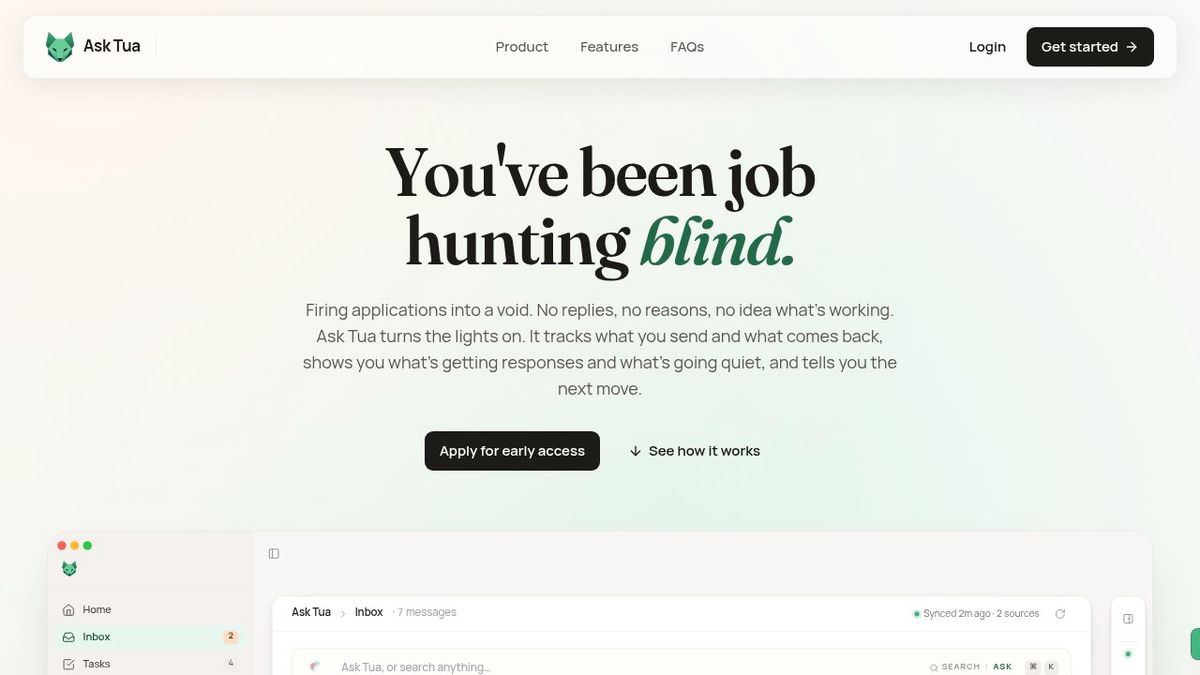
Ask Tua is an AI job search assistant designed to bring the moving parts of your search into one connected workspace. It helps you manage role discovery, applications, recruiter messages, CVs, interviews, follow-ups, outcomes and next moves, with the assistant using that context to support better decisions.
In plain terms, Ask Tua helps job seekers keep the whole search connected, so applications, CVs, messages, interviews and outcomes are not treated as separate tasks.
Ask Tua is currently available through a paid beta for the first 50 users. Early access gives users a way to shape a system built on something most AI job search tools cannot claim: real coaching methodology and a connected workspace that carries context across the search.
Ask Tua is not an automatic application tool. It does not send applications on your behalf or encourage high-volume applications without judgement.
Ask Tua is not a generic chatbot. The assistant is designed to work from your job search context, including your roles, CVs, applications, messages, interviews, follow-ups and outcomes.
Ask Tua is not a tracker-only product. Tracking is part of the workspace, but the larger purpose is to help you understand what is happening in your search and decide what to do next.
Ask Tua is probably not the right fit if you want to send as many applications as possible with minimal involvement. It is designed for candidates who want to run a more deliberate search, keep their context organised and improve the quality of their decisions over time.
Ask Tua's approach is grounded in methodology from over 300 career coaching engagements that generated more than £1.3 million in salary raises. That is not a marketing claim. It is the reason the product is structured around disciplined role targeting, proof-based positioning and a connected workspace where roles, applications, CVs, interviews, messages, follow-ups and outcomes can inform the next move.
The matching logic reflects that philosophy. Rather than surfacing roles based on a vague prompt or a keyword search, Ask Tua starts from structured candidate data: your experience, preferences, target roles and seniority level. Matching is one part of the assistant, but the larger advantage is that role fit, applications, CVs, interviews, messages and outcomes can sit in the same search context.
This is not a tool that takes judgement out of your search. It is a system that organises your search, keeps the context connected and helps you decide what to do next, even around a full-time job.
The value is not in any single feature. It is in the connected workspace underneath the assistant. Here is what a disciplined search looks like inside Ask Tua:
This matters because a job search is not just a list of applications. It is a feedback loop: each reply, rejection, interview and silence tells you something about role fit, positioning, CV quality or follow-up timing.
The result: less time piecing the search together, more context for better decisions and a clearer next move after each application, reply, interview or rejection. A search that fits around your job, rather than competing with it.
The job market is not slowing down, but it is getting more competitive for candidates who do not have a clear system for managing roles, applications, CVs, interviews, follow-ups and outcomes.
The employed professional who starts building a connected search now has a real advantage over the one who waits until urgency takes over. A disciplined system helps you learn from each application, reply, interview and outcome. A scattered one just accumulates stress.
Job searches do not fail because people lack ambition or access to tools. They fail because the process is fragmented, and fragmented processes produce inconsistent results. That is why Ask Tua is not built as a generic chatbot, tracker-only product or automatic application tool.
The answer is not another clever feature. It is a connected workspace that brings together the right roles, application materials, recruiter messages, interview preparation, follow-ups, outcomes and next moves, making it possible to run a serious search while you are still employed.
When comparing AI job search assistants, the useful question is not which tool can generate the most content. It is which tool can keep enough job search context connected to help you make better decisions across the search.
That is what Ask Tua is built to do.
What Ask Tua brings together:
Ask Tua is currently available through a paid beta for the first 50 users. Early access means you help shape the product while using a connected workspace designed for a more disciplined job search.
If you are employed and considering a move, this is the right time to build the system before you need it urgently. Join the Ask Tua paid beta for one of the first 50 early access spots→
An AI job search assistant helps manage the full job search process, from finding relevant roles and tailoring applications to tracking progress, preparing for interviews, managing follow-ups, reviewing outcomes and deciding what to do next. The best ones do more than generate content. They help you run a more structured, more consistent search from one connected context.
Ask Tua does more than rewrite your CV. It connects role discovery, applications, recruiter messages, CV support, interviews, follow-ups, outcomes and next moves in one workspace, so the assistant can use your job search context rather than treating each task in isolation.
Ask Tua is built for employed professionals who want to move without letting the search take over their week. It is especially useful for people in GTM, Operations, Project Management, Customer Support and Customer Success who need an AI job search assistant to keep roles, applications, CVs, interviews, recruiter messages, follow-ups and outcomes connected.
Most tools solve one task in isolation. That creates more activity, but not necessarily better results. Ask Tua focuses on the full workflow, so you can target better roles, tailor more effectively, understand what is working and decide what to do next without losing context.
Ask Tua is currently available through a paid beta for the first 50 users. The current CTA is to join the paid beta for early access, rather than treating Ask Tua as a fully launched public product.
No. Ask Tua is not an automatic application tool and does not send applications on your behalf. It helps you manage the search, judge role fit, prepare stronger materials, track progress and decide what to do next.
No. A generic chatbot starts from the prompt you give it. Ask Tua is an AI job search assistant supported by a connected workspace, so it can use your roles, CVs, applications, messages, interviews, follow-ups and outcomes as job search context.
No. Tracking is part of Ask Tua, but it is not the whole product. Ask Tua is an AI job search assistant that connects applications, CVs, recruiter messages, interviews, follow-ups, outcomes and next moves in one workspace.
Ask Tua is currently available through a paid beta for the first 50 users. Early access gives you a way to use the product while helping shape the workspace, assistant and workflow before a wider public launch.
Ask Tua helps you manage role discovery, applications, CVs, recruiter messages, interviews, follow-ups, outcomes and next moves from one connected workspace. The assistant uses that context to help you run a more disciplined search instead of treating every task separately.
About the Author

Lucien Krogel
Founder & CEO
Lucien founded Ask Tua after six years coaching people through complex job searches. He kept seeing strong candidates lose momentum because their roles, CVs, recruiter messages, interviews, follow-ups and outcomes were scattered across different tools. He built Ask Tua as an AI job search assistant with a connected workspace, so candidates can understand what is happening in their search and decide what to do next.
Full Bio → Blog
BlogThe best tool to organise your job search connects applications, CVs, recruiter messages, interviews, follow-ups and outcomes in one workspace.
Lucien Krogel·July 21, 2026·11 min read Blog
BlogCompare AI job matching and auto-apply tools to see which approach helps you find better-fit roles, avoid generic applications and get more interviews.
Lucien Krogel·July 10, 2026·12 min read Guide
GuideFeel stuck in your job search? Learn why next-step uncertainty happens, how to spot the real signal, and how Ask Tua helps you decide what to do next.
Lucien Krogel·July 23, 2026·12 min read