Why You Never Know What to Do Next in Your Job Search
Feel stuck in your job search? Learn why next-step uncertainty happens, how to spot the real signal, and how Ask Tua helps you decide what to do next.
 Lucien Krogel·July 23, 2026·12 min read
 Author:Lucien Krogel·Founder & CEO
If you have been getting first round interviews and consistently not progressing, the instinct is to blame the market, the volume of applicants, or bad luck with the interviewer. I understand why. Rejection without clear feedback is genuinely difficult to process.
But here is what I have seen across more than 300 career coaching engagements, generating over £1.3M in salary raises for professionals in GTM, Sales, Operations, Customer Success, and Project Management: repeated first round failure is almost never a talent problem. It is a signalling problem.
The data backs this up. Over 70% of UK employers say they struggle to hire for tech roles, yet qualified candidates are still being screened out early. The average role attracts around 280 applications, and only 2% of applicants are invited to a first interview. If you are in that 2%, your profile already has enough pull to get a seat at the table. The question is what happens once you are there.
Three things are almost certainly not the problem:
What is more likely the problem:
These are fixable. Here is how.
Most candidates treat the first round like a full assessment. It is not. It is a fast filter, and the question the interviewer is trying to answer is much narrower than you think.
The real question: Should we invest another two to four hours in this person?
That is it. They are not deciding whether to hire you. They are deciding whether to continue. Understanding this changes how you should prepare.
For mid-level roles in tech, 95% of hiring decisions are based on relevant experience, which means interviewers are not just checking whether you have done the work. They are checking whether you can explain it in a way that maps to the problems they need solved right now.
The three things a first round interviewer is actually assessing:
According to Robert Walters, 80% of professionals believe mid-level roles should require fewer interview rounds. That pressure means early-stage interviewers are making faster, sharper judgements. The candidates who progress are the ones who make all three signals obvious within the first 15 minutes.
This is the most common pattern I see, and it is easy to miss because it feels like you are doing the right thing.
The question is "Tell me about yourself." You take a breath and walk the interviewer through your career, role by role, in roughly chronological order. By the time you finish, three minutes have passed and the interviewer is still waiting to hear why any of it is relevant to them.
The problem: you are presenting your history. They want to hear your fit.
History answer: "I spent three years at [Company] as an Account Manager, then moved into a Senior AE role where I managed a portfolio of around 40 accounts across the EMEA region..."
Relevance answer: "My background is in enterprise sales in SaaS, where I consistently worked on complex, multi-stakeholder deals. In my last role I grew net revenue retention in my book from 91% to 107% over 18 months by building stronger executive relationships. I am looking to bring that into a business where expansion revenue is a growth priority, which is exactly what drew me to this role."
The second answer is not longer. It is just pointed at the right target.
The fix:
Tech companies at mid-level are not just hiring people who can do the work. They are hiring people who understand why the work matters to the business.
This has become sharper over the past two years. In Customer Success, hiring is increasingly focused on strategic partnership and revenue thinking rather than account administration. In Operations and Project Management, AI is taking over much of the execution-heavy, process-following work, which means the humans in those roles need to demonstrate judgement, prioritisation, and commercial impact.
If your answers describe what you did without explaining what it achieved or why it mattered, you sound capable but not useful at the level the role requires.
The fix: for every major example you plan to use, add the business implication. What changed because of what you did? Who cared, and why?
17% of candidates are rejected specifically for poor communication skills. That figure almost certainly underestimates the real number, because many rejections that get labelled "not the right fit" are actually communication failures in disguise.
The issue is not that candidates say the wrong things. It is that they are hard to follow. Interviewers are making quick judgements about whether they would trust you to represent the team in a customer meeting, a cross-functional discussion, or a board update. Muddy communication kills that trust fast.
Use this structure for any behavioural or situational question:
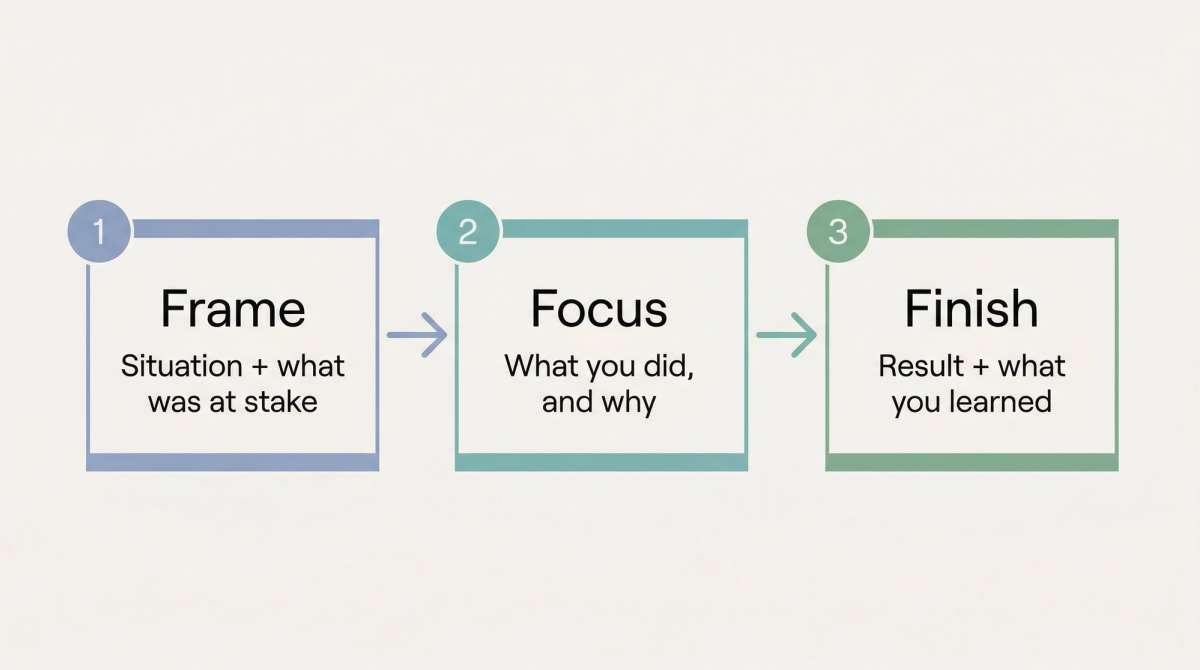
Three beats. Thirty to ninety seconds. The interviewer can follow it, extract the point, and move on. That is what you want.
The goal is not to sound polished. It is to sound clear. Clarity signals competence more reliably than confidence does.
This one is harder to diagnose because it does not feel like a mistake. You prepared thoroughly. Your answers were structured. You were professional throughout. And you still did not progress.
The issue is that interviewers are also asking themselves whether they would want to work with you. Not just whether you can do the job, but whether they would trust you with a difficult customer, a messy cross-functional project, or an uncomfortable conversation with a stakeholder. That judgement is made on texture, not just content.
When candidates over-prepare with scripted answers, they often strip out the very things that make them credible: specific opinions, real trade-offs they navigated, moments where they pushed back or changed their mind.
Polished but hollow: "I am a strong collaborator who thrives in fast-paced environments and enjoys working cross-functionally to drive outcomes."
Human and credible: "I had a situation at [Company] where the engineering lead and I disagreed on the scope of a launch. I pushed back because I thought we were cutting corners that would cost us in post-launch support. We compromised, shipped a smaller feature set, and I turned out to be right about the support load. It was a good outcome but a difficult conversation."
The second answer is specific, opinionated, and honest. It shows judgement. That is what gets people hired.
The fix: do not rehearse answers until they are smooth. Rehearse them until they are true.
Most interview prep is unfocused. People re-read the job description, rehearse a few answers, and hope for the best. This is a system that treats preparation as a formality rather than a competitive advantage.
Here is a tighter approach, built from the patterns that actually move candidates forward.
Use this in the 48 hours before any first round interview.
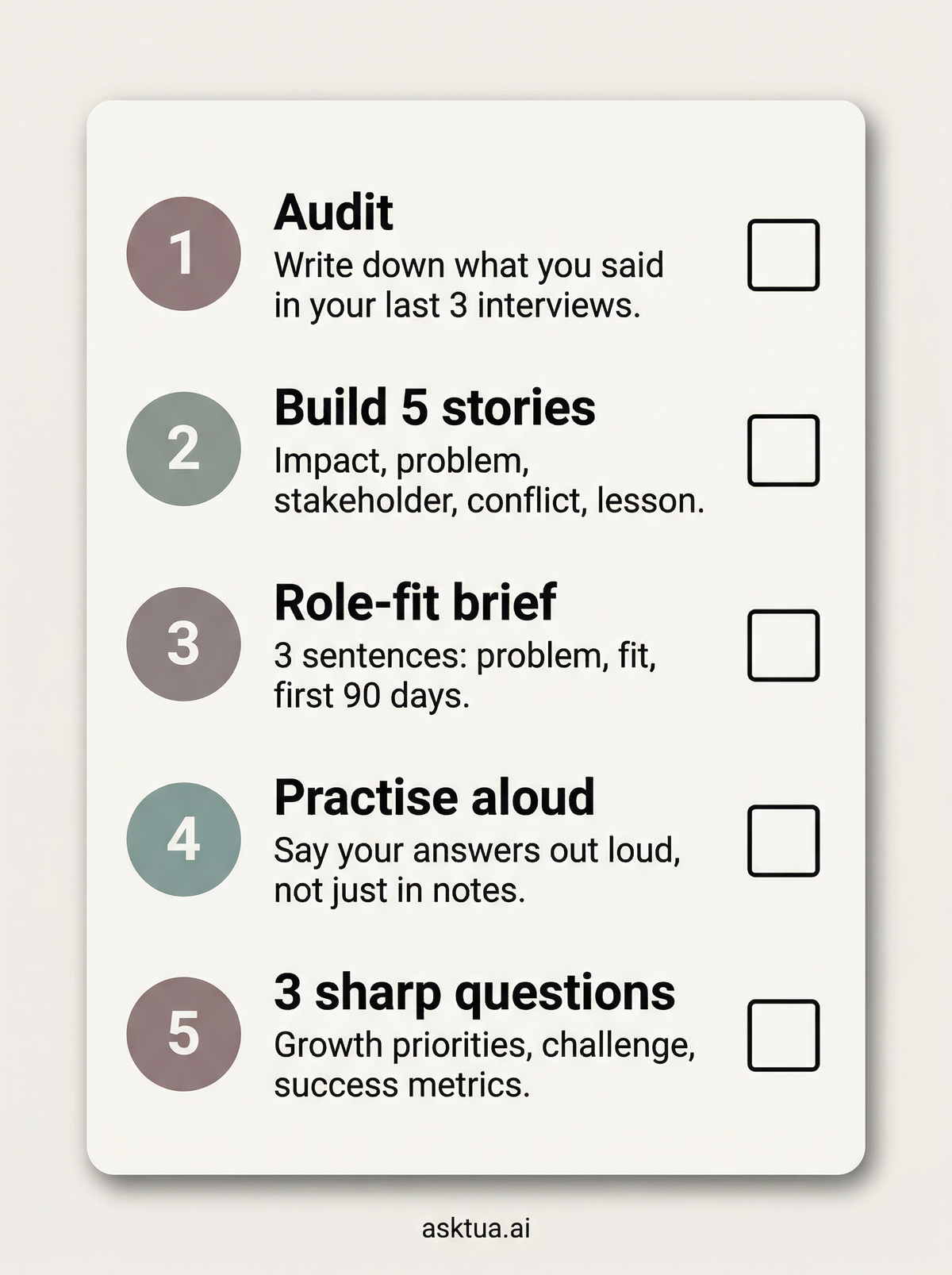
If you are landing first round interviews, you are already past the hardest filter. Your profile is working. The gap is almost always in how you show up once you are in the room.
The fix is not to become a different person or a more polished performer. It is to get clearer on what you are actually being assessed on, and to prepare with that in mind.
Every one of these is solvable.
If you want a more structured system for your job search, including interview prep built around your specific role and target companies, Ask Tua is opening its first 50 beta spots soon. Built on the same methodology behind 300+ coaching engagements and £1.3M+ in salary raises. Join the waitlist and be first in.
Most first round failures come down to signal, not skill. Interviewers want to see role fit, commercial relevance, and clear thinking quickly. If your answers are too historical, too vague, or too polished to feel real, you make it harder for them to picture you in the job.
They are usually asking one question: should we spend more time on this person? That means they are screening for relevance, communication quality, and whether your examples map to the business problem the role is meant to solve.
Link every answer to impact. Don’t just say what you did, say what changed because of it. Use outcomes like revenue, retention, cycle time, stakeholder buy-in, or cost savings, and make the business implication obvious.
Audit your last few interviews for patterns, then build five core stories you can adapt to most questions. Practise them aloud, not just in notes, and make sure each one has a clear beginning, middle, and finish.
Yes, if it helps you structure ideas or practise answers. No, if it makes your delivery sound generic or scripted. The strongest interviews still sound human, specific, and grounded in real experience.
About the Author

Lucien Krogel
Founder & CEO
Lucien founded Ask Tua after six years coaching people through complex job searches. He kept seeing strong candidates lose momentum because their roles, CVs, recruiter messages, interviews, follow-ups and outcomes were scattered across different tools. He built Ask Tua as an AI job search assistant with a connected workspace, so candidates can understand what is happening in their search and decide what to do next.
Full Bio → Guide
GuideFeel stuck in your job search? Learn why next-step uncertainty happens, how to spot the real signal, and how Ask Tua helps you decide what to do next.
Lucien Krogel·July 23, 2026·12 min read Guide
GuideLearn how to track job applications, recruiter messages, follow-ups, interview stages and next actions in one connected job search system.
Lucien Krogel·July 22, 2026·11 min read Guide
GuideCompare the best AI job search assistant for active searches. See what matters, what ChatGPT misses, and why connected context changes the result.
Lucien Krogel·July 21, 2026·12 min read